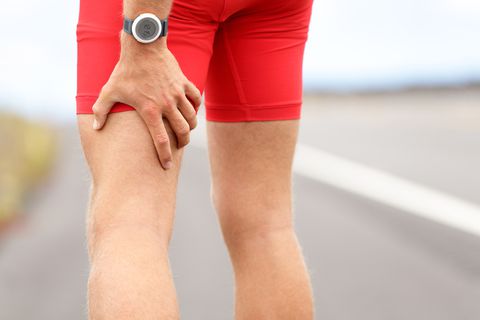
Recovering from a knee injury or ACL surgery? You might feel stronger, but how do you know whether your muscles are ready for sport?
Biodex strength testing provides objective measurements of muscle strength. Unlike traditional tests, it can identify differences between your legs that may not be obvious during everyday movements.
Quick answer
- Traditional strength tests: Assess muscle strength through resistance, movement or functional tasks.
- Biodex testing: Measures muscle force during controlled movements using specialist equipment.
- Main benefit: Identifies strength differences and helps track rehabilitation progress.
- Best approach: Combine objective strength testing with movement assessments and progressive rehabilitation.
What is Biodex strength testing?
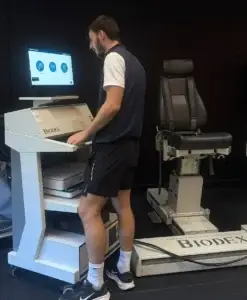
Biodex strength testing uses an isokinetic dynamometer, a specialist machine that measures muscle strength during controlled movements.
The machine controls movement speed while measuring the force your muscles produce.
It is commonly used to assess the quadriceps and hamstrings, particularly following knee injuries or ACL reconstruction.
Testing can help identify:
- Muscle weakness following injury or surgery.
- Strength differences between your legs.
- Imbalances between quadriceps and hamstrings.
- Changes in strength throughout rehabilitation.
These measurements provide useful information when planning your recovery.
Biodex strength testing vs traditional tests: what’s the difference?
Traditional strength testing may involve manual resistance, handheld devices or exercises such as squats and single-leg movements.
These methods can help assess strength and movement. However, some provide less detailed information about individual muscle groups.
Biodex testing offers standardised measurements that can be compared over time.
| Traditional strength tests | Biodex strength testing |
| May use manual resistance or functional movements | Uses specialist strength-testing equipment |
| Some tests rely on clinical judgement | Provides numerical strength measurements |
| Can assess everyday movement and control | Measures specific muscle groups |
| Usually requires minimal equipment | Requires a dedicated machine |
| Useful throughout rehabilitation | Useful for detailed strength assessment |
Both approaches have value. Handheld dynamometers can also provide objective strength measurements, so not all traditional tests are subjective.
Research supports isokinetic dynamometry as a reliable method of assessing muscle strength.
Why is limb-symmetry testing important?
Following an injury, your affected leg may remain weaker even when pain and swelling have improved.
Limb symmetry compares the strength of one leg with the other.
For example, you might feel comfortable walking or climbing stairs but still have weakness during more demanding movements.
Biodex testing can highlight these differences and help your physiotherapist adjust your rehabilitation.
However, equal strength between your legs doesn’t automatically mean you’re ready for sport. Both legs may have lost strength during recovery.
Who can benefit from Biodex strength testing?
Biodex testing may be useful for people:
- Recovering from ACL reconstruction.
- Rehabilitating after knee surgery.
- Returning to football, rugby or running.
- Experiencing ongoing weakness after injury.
- Wanting objective measurements of rehabilitation progress.
It can be particularly helpful when preparing to return to sports involving sprinting, jumping or changing direction.
Can Biodex testing tell you when you’re ready to return to sport?
Biodex testing provides valuable strength information, but it cannot determine sporting readiness on its own.
Your physiotherapist should also consider:
- Knee stability and movement.
- Balance and coordination.
- Jumping and landing control.
- Sport-specific movements.
- Confidence and previous injury history.
The Aspetar ACL rehabilitation guideline recommends objective strength testing alongside functional assessments when making return-to-sport decisions.
Therefore, Biodex testing works best as part of a wider rehabilitation programme.
When should you see a physio?
Consider booking an assessment if:
- Your injured leg still feels weaker.
- You’re struggling to regain strength after surgery.
- You’re unsure whether you’re ready for sport.
- Your rehabilitation progress has slowed.
- You want measurable information about your recovery.
Seek urgent medical help for sudden severe pain, significant swelling, inability to bear weight or a hot, swollen joint with fever.
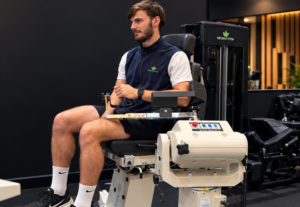
How Releaf Physio uses Biodex testing in Newcastle
Our HCPC-registered physiotherapists provide rehabilitation and strength assessment at Gosforth and Cobalt Business Park, Newcastle upon Tyne.
- Assess your recovery: Discuss your injury, symptoms and sporting goals.
- Measure your strength: Use Biodex strength and limb-symmetry testing when appropriate.
- Identify weaknesses: Review strength differences and areas needing improvement.
- Build your plan: Develop a personalised sports injury rehabilitation programme to support your return to activity.
Where appropriate, AlterG treadmill rehabilitation may also support your return to running.
Our focus is helping you understand your progress and return to sport with greater confidence.
Biodex strength testing FAQs
Is Biodex strength testing painful?
Testing involves controlled muscle contractions and may feel physically demanding. Your physiotherapist will assess whether it’s appropriate for your stage of recovery.
How long does Biodex testing take?
Appointment length depends on the muscles being assessed and your rehabilitation needs. Releaf can explain what to expect when booking.
Is Biodex testing better than traditional strength testing?
Biodex provides detailed, objective measurements. However, traditional strength and functional tests remain valuable for assessing movement and sporting readiness.
Do I need Biodex testing after ACL surgery?
Not everyone requires Biodex testing. However, it can provide useful information about strength recovery and help guide return-to-sport decisions.
Understand your strength. Return with confidence.
Feeling stronger is encouraging, but objective testing can help show how your rehabilitation is progressing.
At Releaf Physio, we combine Biodex strength testing with personalised rehabilitation to support your return to sport.
Book online with Releaf Physio or call 0191 691 1299 for a free phone consultation.
References
- Aspetar Clinical Practice Guideline on Rehabilitation After ACL Reconstruction (2023) – Recommendations for strength testing, rehabilitation and return-to-sport assessment.
- American Physical Therapy Association – Hand-Held Myometry/Dynamometry – Explains objective muscle strength testing and differences between handheld and isokinetic dynamometry.